
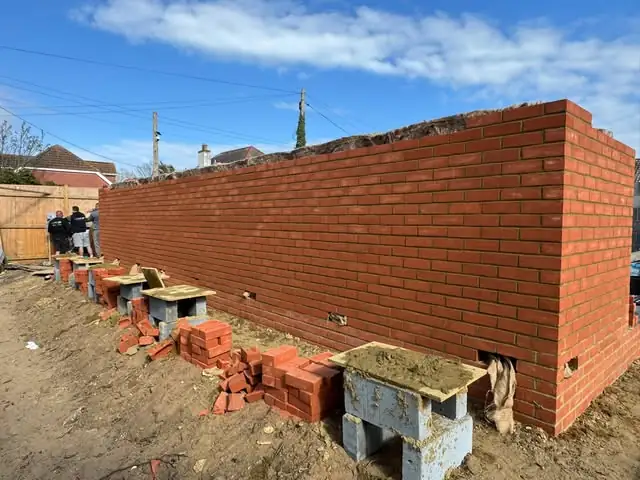
A brick bond is the pattern the bricks are laid in. Each course is set out so the vertical joints do not line up with the course below, which spreads the load and ties the wall together. The most common bonds you will see on homes are stretcher bond, English bond and Flemish bond, plus the garden wall versions of the last two. The right one depends on how thick the wall is, what it has to do and what it needs to match.
Why bricks are bonded at all
If you stacked bricks straight on top of each other, every vertical joint would line up and the wall would split along those lines. Overlapping the bricks means each brick sits across two below it, so weight and movement are shared. In thicker walls, some bricks are also turned sideways so they reach through the wall and tie the two faces together.
Two words help: a stretcher is a brick laid lengthways, showing its long face. A header is a brick laid end on, showing its short end.
Stretcher bond
Every brick is a stretcher, and each course is shifted by half a brick. It is the bond on almost every modern house, because modern walls are cavity walls: an outer skin of brick, a gap, then an inner skin of block. The outer skin is only one brick thick, so there is nothing for headers to tie into.
- Used for: house walls, extensions, porches, single skin garden walls
- Look: neat and plain, the pattern most people picture
English bond
A course of stretchers, then a course of headers, repeated. Because the headers run through the wall, English bond is very strong and is usually found in solid walls that are at least one full brick thick. You will see it on older buildings, bridges, railway walls and retaining walls.
- Used for: solid walls, retaining walls, piers and heavier garden walls
- Look: strong horizontal bands
Flemish bond
Each course alternates header, stretcher, header, stretcher, with the headers centred on the stretchers above and below. It is the classic bond of Georgian and Victorian solid walled houses, and it gives a more decorative, even pattern than English bond.
- Used for: period homes and front walls designed to match them
- Look: a regular chequered pattern
Garden wall bonds
English garden wall bond has three or five courses of stretchers between each course of headers. Flemish garden wall bond has three stretchers between each header in a course. Both use fewer headers, which makes them quicker to build and easier to keep both faces of a thick wall looking tidy. As the names suggest, they are a popular choice for one brick thick garden and boundary walls.
Other patterns you may see
- Stack bond: bricks lined up straight above each other. It looks modern but is weak on its own, so it is only used as cladding or with hidden reinforcement.
- Header bond: all headers, often used on tight curves because the short faces follow the curve neatly.
- Soldier courses: bricks stood on end, often over windows or along the top of a wall as a feature.
Which bond for which job?
- Extension or new house wall: stretcher bond, to match the cavity wall construction. See our extension brickwork.
- Low front wall, half a brick thick: stretcher bond with piers for strength.
- Front or boundary wall, one brick thick: English garden wall or Flemish garden wall bond, so both sides look finished. See our garden walls.
- Retaining wall: often English bond, or a reinforced design, depending on the height and the load.
Matching an existing bond
When you extend a house or rebuild part of a wall, the new work should carry on the old bond. Count the courses, look at where the headers fall and check the brick size. Older homes often used imperial bricks, which are slightly bigger than modern metric ones, so the courses will not line up unless that is allowed for. Matching the mortar colour and joint finish matters just as much as the bond. Our guide to lime or cement mortar explains why.
Getting the bond right is part of what we do every day as bricklayers with over 18 years on the tools. We are based in Bexleyheath and work across Bexley, Chislehurst and the surrounding areas. For a free written quote, get in touch.