
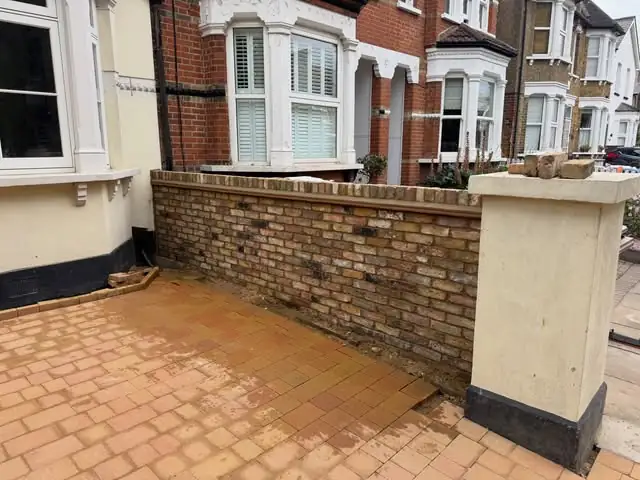
Laying block paving for a driveway follows a set order: dig out to the right depth, build and compact a sub base, fit the edge restraints, screed a sand laying course, lay the blocks, cut in the edges, compact the surface and brush kiln dried sand into the joints. Each stage depends on the one below it, which is why a drive that looks fine on day one can sink within a few years if the early stages are rushed.
1. Survey and set out
Before anything is dug, the levels are worked out. The finished drive needs a fall so water runs off, and it must sit below the damp proof course of the house where it meets the wall. The drainage also needs planning: in England, paving more than 5 square metres of a front garden must be permeable or drain onto a lawn, border or soakaway on your land, unless you have planning permission. Manhole covers, steps and the pavement edge are all taken into account.
2. Dig out
The old surface and soil are removed down to a depth that allows for the sub base, the laying course and the blocks. For a driveway that carries cars this is deeper than for a path or patio. Soft spots are dug out further. All spoil is loaded and taken away.
3. Build the sub base
Crushed stone sub base is spread in layers and each layer is compacted with a heavy plate compactor or roller. Compacting in layers matters: one thick layer compacted only on top leaves a soft middle that settles under the weight of a car. The finished sub base follows the planned falls.
4. Fit the edge restraints
Block paving is a flexible surface that holds together by being boxed in. Kerbs, edging blocks or a border are set in concrete around the whole area, so the blocks cannot creep outwards. Weak edges are one of the most common causes of joints opening up and blocks working loose.
5. Screed the laying course
A layer of sharp sand is spread and screeded to an even depth between rails, so it follows the falls exactly. Once screeded, it is not walked on. The sand gives the blocks an even bed to settle into.
6. Lay the blocks
The blocks are laid from a fixed edge, working forwards off the blocks already laid. Patterns vary:
- Herringbone: the strongest choice for driveways, because the interlocking pattern resists turning tyres
- Basketweave: decorative, better for paths and patios
- Stretcher: simple rows, often used for borders
Blocks are taken from several packs at once so the colour mixes evenly across the drive.
7. Cut in the edges
Gaps at the edges and around manholes and walls are filled with blocks cut to size. Small slivers are avoided, because they work loose. Clean, tight cuts are what make a drive look properly finished.
8. Compact and sand
Kiln dried sand is brushed over the surface, and the whole area is compacted with a plate compactor fitted with a protective mat. This pushes the blocks down into the laying course and drives sand up into the joints. More sand is brushed in and the surface compacted again until the joints are full. The sand locks the blocks together so the surface works as one.
9. Finish and aftercare
The drive is swept clean and checked for level. Over the first weeks, the joint sand settles and may need topping up. Our guide to sanding and weeding block paving covers the aftercare, and our guide on how to seal block paving explains when sealing is worth it.
Front walls and piers to finish
As bricklayers, we often build a new front wall, piers or gate posts as part of the same job, matched to the house. See our driveways and block paving pages for how we work.
We are based in Bexleyheath and build block paved driveways across Dagenham, Rainham and the surrounding areas. Ask for a free written quote and Ricky will come out to look at your drive.