
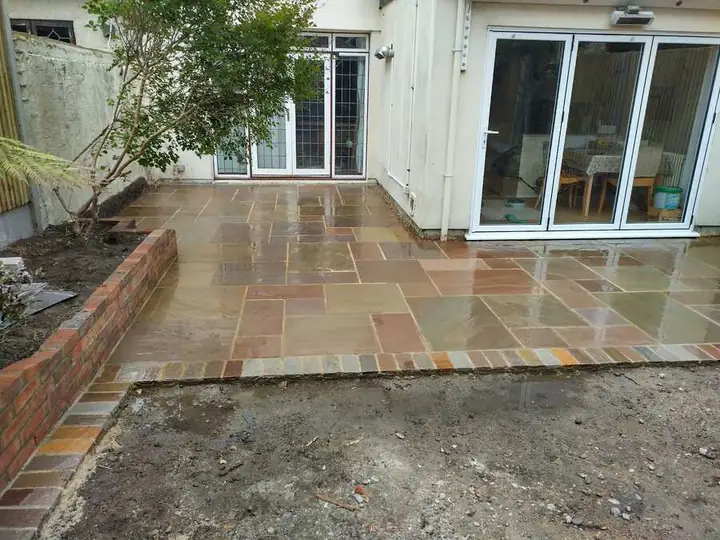
The cost of a patio depends mainly on three things: the material you choose, the size and shape of the area, and how much preparation the ground needs. Porcelain, Indian sandstone and other natural stones differ in what they cost to buy and how long they take to lay, while the dig out, the sub base, the levels and any steps or walls can make as much difference as the slabs themselves. Here is how each part affects the price.
Choosing a material
Porcelain
- Look: clean and modern, with stone and wood effect ranges
- Upkeep: very low. Porcelain hardly absorbs water, so it resists stains, moss and algae
- Labour: higher. It is hard and dense, so cuts need special blades, every slab needs a priming slurry on the back, and the slabs are thin and unforgiving of an uneven bed
Indian sandstone
- Look: natural colour variation, often with a riven, textured surface, and a traditional feel
- Upkeep: moderate. It is more porous than porcelain, so it can weather, darken and grow moss in shady spots unless cleaned or sealed
- Labour: riven slabs vary in thickness, so each one is bedded individually to sit level, which takes time
Read more on our Indian sandstone patios page.
Limestone, slate and other stone
Smooth sawn limestone gives a smart, contemporary finish, and slate is dark and striking. Both vary in porosity and care, and both are priced somewhere between the others depending on the range.
Block and brick paving
Block paving can also be used for patios, paths and edging. It is laid differently, on sand rather than mortar, and suits some gardens well.
Size and shape
Bigger patios cost more in total but often less for each square metre, because setting up and finishing take a similar time whatever the size. Curves, lots of corners, circles, and patterns with mixed slab sizes all need more cutting and more time.
Base preparation
This is the biggest hidden cost, and the one that decides how long the patio lasts.
- Digging out: how deep, how hard the ground is, and whether there is old paving or concrete to break up
- Waste removal: spoil and old slabs need taking away
- Sub base: a compacted layer of crushed stone, laid in stages
- Full mortar bed: every slab bedded fully, not on dabs
A patio priced low because it skips the sub base or uses dabs of mortar usually ends up rocking and pooling.
Levels, falls and drainage
A flat site close to the right level is the simplest. A sloping garden may need retaining walls, steps or a raised patio. If the patio meets the house, the finished surface should be at least 150mm below the damp proof course, which may mean digging down further. Water then needs somewhere to go. Our patio drainage guide explains the options.
Walls, steps and extras
- Brick steps up to the house or down to the lawn
- Retaining walls on sloping sites
- Raised beds, planters and seating walls
- Edging, borders and paths
As bricklayers, we build all of these as part of the same job, finished to match.
Upkeep over the years
It is worth thinking about the running costs as well as the price of laying. Porcelain needs little more than a sweep and a wash. Natural stone may need cleaning more often in shady corners, and some owners choose to seal it. Full, well finished joints on either material keep weeds out and save time every year.
Access
If materials and spoil have to go through the house or down a narrow side passage, the work takes longer than on a garden with open access.
Getting a price for your patio
RS Kayley Ltd prices every patio after a free visit, and we can bring samples so you can see porcelain and stone in your own garden. The written quote sets out exactly what is included. See how we build them in our guide to laying a patio, and on our patios page.
We are based in Bexleyheath and lay patios across Upminster, Greenwich and the surrounding areas. Ask for a free written quote.